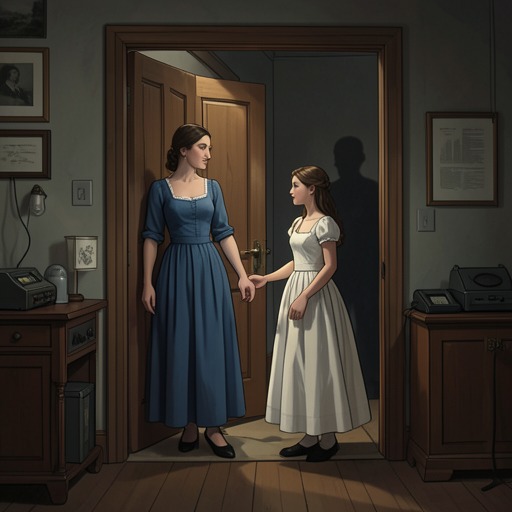
Bianca
The Castle of OtrantoBianca, a young attendant to Matilda, serves as a conduit between the castle’s servants and its princesses during the upheaval at Otranto. Her reports bring rumors and eyewitness accounts of supernatural disturbances into the private rooms of the women, and her suspicions about Isabella’s disappearance expose how much remains uncertain to those inside the castle. Later, Manfred attempts to use her access to the young women’s confidence to learn about Isabella’s affections; Bianca’s anxious, indirect answers frustrate his inquiry and lead her to recount another apparition.
Identity and Place in the Household
Bianca attends Matilda, and Matilda sends her to find out what has become of Isabella. Bianca returns with what she has gathered from the servants: Isabella is nowhere to be found, and a young peasant has been discovered in the vault. The accounts she passes on are not precise; she adds details drawn from the domestics’ incoherent reports. Her place between the servants and the princesses gives her access to information the women cannot witness directly, but the chain of hearsay also makes her accounts uncertain.
The distinction between report and observation matters in Bianca’s role. She dwells on a gigantic leg and foot said to have appeared in the gallery chamber, an episode that has frightened her so greatly that she is glad Matilda intends to remain awake rather than go to rest. Bianca is therefore not simply a messenger of verified facts: she carries the castle’s fear as well as its news, and her alarm marks how the apparitions have spread beyond the people who directly encounter them.
Reading Isabella’s Disappearance
As Matilda tries to understand the events, Bianca offers a more suspicious interpretation than her mistress initially accepts. She argues that Manfred’s questions about Isabella may not come from mere curiosity. According to Lopez, the servants believe the young peasant helped Isabella escape; Bianca adds that Isabella never much liked Matilda’s brother, who has just died. She places these facts beside the story that a helmet fell from the moon, then reports the servants’ alternative rumor that the stranger is a magician who stole it from Alfonso’s tomb. Bianca expressly stops short of accusing anyone, but her juxtaposition invites Matilda to consider whether the death, the stranger, and Isabella’s flight are connected.
Matilda rejects Bianca’s account as impertinent, yet concedes that Isabella’s flight and the stranger’s curiosity are puzzling. Bianca presses the possibility that the stranger is a prince in disguise and asks to question him herself. Matilda refuses, saying she will ask whether he knows anything of Isabella, though she considers him unworthy of further conversation. Before she can open the window, a bell rings at the castle’s postern gate and interrupts the exchange.
Afterward, Matilda reasons that Isabella’s flight had no dishonorable motive. If the stranger helped her, Matilda believes, Isabella must trust his fidelity and worth; she also recalls the piety and gentility of his speech. Bianca’s suggestion of hidden princely identity thus finds a receptive opening, even as Matilda’s judgment rests on her own impression of the stranger rather than on proof. Their exchange gives the uncertainty around Isabella several competing forms: servant gossip, Bianca’s inference, and Matilda’s confidence in Isabella’s character.
Manfred’s Inquiry
Later, Manfred encounters Bianca while crossing the great hall on his way to the Marquis. Knowing that she is trusted by both young women, he draws her into the recess of an oriel window and questions her about Isabella’s feelings. He softens the inquiry with fair words and promises, then asks whether there is a young man in Isabella’s confidence. His approach treats Bianca’s intimacy with the young women as a source of information he can exploit.
Bianca answers haltingly, first denying and then seeming to affirm that she knows something. Instead of directly addressing the question, she says Isabella is greatly alarmed about her father’s wounds and reassures Manfred that she expects him to recover. Manfred corrects her and insists that she speak about Isabella’s affections. The exchange shows Bianca’s reluctance or inability to give him a straightforward answer; the evidence does not establish whether she is deliberately concealing information, protecting Isabella, or simply flustered by the questioning.
The Armored Hand and Bianca’s Narrative Role
In the presence of Manfred and Frederic, Bianca reports a further supernatural sighting. She attributes to Jaquez the belief that the moon will not pass without a strange revolution, and says she would not be surprised if it happened the next day. She then recounts hearing armor clatter and seeing, on the uppermost banister of the great stairs, an enormous armored hand. Frightened, she says she ran to where the others were and adds that Matilda had told her the previous morning that Hippolita knew something.
The report prompts Manfred to call Bianca insolent and to suspect that the scene has been arranged to affront him. He accuses the Marquis of using servants to spread damaging tales; Frederic denies having ever seen Bianca or given her a jewel, and turns the charge back on Manfred’s conscience and guilt. Bianca’s account consequently does more than add another apparition to the castle’s accumulating wonders: it becomes part of a public dispute over who is spreading rumors and whether Manfred’s authority can command belief. Across these episodes, Bianca is neither an authoritative expositor nor a mere comic interruption. Her mixture of hearsay, inference, and direct observation gives the castle’s hidden fears a voice, while the different reactions to her reports reveal the divide between servants’ suspicions and the rulers’ attempts to control events.